As I've been teaching Bible classes regularly the last couple years, I've found it helpful to tie together different sections of the Bible to show how the writings complement each other. As I teach the letters of Paul, I think it's good to go back to Acts as you read his letters and see if there may be any helpful information that Acts provides. So, in Luke's account of Paul's ministry in Ephesus (Acts 19), you learn that Ephesus has a strong community dedicated to the cult and magic. When you read Ephesians, you notice that Paul, more than any other letter of his, uses language of our victory in Christ in the "heavenlies" and strong language of "spiritual warfare" (Eph 6:12-20- maybe in another post I can talk more about this). No coincidence.
When I went back to Acts recently, I noticed a few parallels between its account of Paul's ministry in Corinth (Acts 18) and Paul's 1st letter to the Corinthians, some are minor, some helpful. I thought I'd list them out for my reader.
1. Acts 18:3 says that Paul worked in Corinth as a tentmaker, which fits with his account that he worked rather than have the Corinthians "pay his way" (1 Cor 4:12; 9:6, 18- see also 1 Thess 2:9- this seems to have been Paul's modus operandi).
2. Acts 18:5-6 note that Paul's ministry to the Jews in the synagogues was largely unsuccessful, so much so that he declared "from now on I will go to the Gentiles." Sure enough, it seems reasonably obvious that Paul's Corinthian audience is mostly Gentile.
3. Luke tells us that "Crispus, the synagogue leader, and his entire household believed in the Lord; and many of the Corinthians who heard Paul believed and were baptized" (18:8). Paul mentions baptizing Crispus in 1 Cor 1:14.
4. While Paul was in Corinth, "the Lord spoke to Paul in a vision: 'Do not be afraid; keep on speaking, do not be silent. For I am with you, and no one is going to attach and harm you, because I have many people in this city" (Acts 18:9-10). It isn't a stretch to assume, then, that Paul was afraid. In Paul's own words, "I came to you in weakness with great and trembling" (1 Cor 2:3).
5. Luke also records the beating of Sosthenes, another synagogue leader, at the hands of an angry mob (18:17). He was, presumably, a believer, and eventual "cowriter" (using that term loosely) of Paul's letter to the Corinthians (1:1- I wonder if he left Corinth because of the beating?).
6. Finally, after they all leave Corinth, Priscilla and Aquilla, Paul's coworkers, meet Apollos in Ephesus. Luke tells us "He was a learned man, with a thorough knowledge of the Scriptures...and he spoke with great fervor" (Acts 18:24-25), who was then taught more thoroughly by Priscilla and Aquilla. After this, Apollos ministered in Achaia and Corinth (Achaia is the overall region where Corinth was located) and "vigorously refuted the Jews in public debate" (18:28).
Interestingly, this seems to have caused some unintended problems within the church at Corinth. We learn that some chose to follow Apollos, while some chose to follow others (1 Cor 1:12). It seems that some of the Corinthians had rejected Paul on the basis of his lack of "wisdom" and "eloquence" (1 Cor 1:18-2:16; see also 2 Cor 10:10). Could it be that after experiencing Apollos' rhetorical abilities and his knowledge that some had placed Apollos higher on the "spiritual" scale than Paul? It would seem that their love for wisdom and persuasive rhetoric would certainly make this possible, if not probable (1 Cor 1:22; 2:1-5). Of course, Paul doesn't blame Apollos; he was, after all, doing his job of watering the seed that Paul had laid down (3:6). And it's clear that Apollos was no longer in Corinth when this letter was written (16:12), so the divisions probably happened after his departure.
None of these 6 points, mind you, are necessarily crucial to understanding Paul's letter. In fact, it seems to me that numbers 3 and 5 are purely incidental, number 1 confirms what we already know in other letters, number 2 gives us a good understanding why Paul's audience in this letter seems so Gentile (and also confirms what we know from other letters- he was the apostle to the Gentiles, after all), and numbers 4 (on Paul's fear) and 6 (on Apollos' abilities) give us some interesting background that proves to be more helpful- especially the last point.
Friday, March 14, 2008

Thursday, March 13, 2008
I've been tagged: Bible Meme
Cousin Jeremy (who incidentally will be legally changing his name to Cousin Jeremy soon) tagged me for this. Now, apparently as I do one of these I'm under contractual obligation to make a disclaimer along the lines of "I normally don't do these things, but... (my excuse: I can't sleep tonight)", so please consider it done. Thank you.
1. What translation of the Bible do you like best?
Although a long time user of the NASB, I might have to go with the TNIV- I've become a big proponent. Sorry, Jimmy Dobson.
2. Old or New Testament?
I'm with Jeremy on this one- aren't they both the Bible? I'm tempted to say the Apocrypha.
3. Favorite Book of the Bible?
Oh gosh. 1 Corinthians, because it has so much going on in it, I love using it for teaching. Philippians because it's downright awesome. Revelation because it's so different. Isaiah because it carries so many of the major themes of the Bible. I could go on.
4. Favorite Chapter?
1 Corinthians 15. Without a doubt. Philippians 2 pulls into second place. Or maybe Isaiah 53. Or maybe Psalm 103. Or Daniel 7. Or Revelation 4. Or Revelation 5. Or...
5. Favorite Verse?
For now, 2 Peter 1:3- "His divine power has given us everything we need for a godly life through our knowledge of him who called us by his own glory and goodness." (TNIV)
6. Bible character you think you're most like?
Daniel- because we share a name and are both prone to frequent angelic visitations.
7. One thing from the Bible that confuses you?
Only one? I have always wondered what Jesus really meant when he said "God is spirit, and his worshippers must worship in the Spirit and in truth." I've heard many explanations, but none have ever satisfied me.
8. Moses or Paul?
In a steel cage match to the death? Moses. But otherwise... let's break this down like a boxing match-
Canonical writings: Moses- the Pentateuch vs. Paul- 13 letters: advantage- even
Divine Encounters: Moses- the burning bush vs. Paul- the risen Christ: advantage- Paul
Guest Preacher: Moses- slow of speech & tongue vs. Paul- unimpressive: advantage- even
Miracles: Moses- 10 Plagues, parting the Red Sea vs. Paul- numerous healings: advantage- Moses
Helpers: Moses- Aaron, Miriam vs. Paul- Timothy, Silas, Barnabas, Luke, etc: advantage- Paul
Difficulties: Moses- rebellious, complaining people, dry desert air vs. Paul- ungrateful churches, imprisonment, beatings, "thorn in the flesh", eventual martyrdom: advantage- Paul
Movie Portrayals: Moses- Charlton Heston in The 10 Commandments vs. Paul- Anthony Hopkins in Peter & Paul: advantage- Moses
Winner: Paul
9. A teaching from the Bible that you struggle with or don't get?
The teachings on caring for the poor are something I struggle with, not in understanding them but what that looks like for a 21st century American.
10. Coolest name in the Bible?
Mephibosheth
So I have to tag 5 people? How about the Neaves, Andrew, Jan, Brian and Isaac, except I don't know if he has a blog, so he can put his answers in the comments section.
Oh, and the answer to #6 was a bit of a joke, in case anyone was wondering.
1. What translation of the Bible do you like best?
Although a long time user of the NASB, I might have to go with the TNIV- I've become a big proponent. Sorry, Jimmy Dobson.
2. Old or New Testament?
I'm with Jeremy on this one- aren't they both the Bible? I'm tempted to say the Apocrypha.
3. Favorite Book of the Bible?
Oh gosh. 1 Corinthians, because it has so much going on in it, I love using it for teaching. Philippians because it's downright awesome. Revelation because it's so different. Isaiah because it carries so many of the major themes of the Bible. I could go on.
4. Favorite Chapter?
1 Corinthians 15. Without a doubt. Philippians 2 pulls into second place. Or maybe Isaiah 53. Or maybe Psalm 103. Or Daniel 7. Or Revelation 4. Or Revelation 5. Or...
5. Favorite Verse?
For now, 2 Peter 1:3- "His divine power has given us everything we need for a godly life through our knowledge of him who called us by his own glory and goodness." (TNIV)
6. Bible character you think you're most like?
Daniel- because we share a name and are both prone to frequent angelic visitations.
7. One thing from the Bible that confuses you?
Only one? I have always wondered what Jesus really meant when he said "God is spirit, and his worshippers must worship in the Spirit and in truth." I've heard many explanations, but none have ever satisfied me.
8. Moses or Paul?
In a steel cage match to the death? Moses. But otherwise... let's break this down like a boxing match-
Moses & Paul: the Tale of the Tape
Canonical writings: Moses- the Pentateuch vs. Paul- 13 letters: advantage- even
Divine Encounters: Moses- the burning bush vs. Paul- the risen Christ: advantage- Paul
Guest Preacher: Moses- slow of speech & tongue vs. Paul- unimpressive: advantage- even
Miracles: Moses- 10 Plagues, parting the Red Sea vs. Paul- numerous healings: advantage- Moses
Helpers: Moses- Aaron, Miriam vs. Paul- Timothy, Silas, Barnabas, Luke, etc: advantage- Paul
Difficulties: Moses- rebellious, complaining people, dry desert air vs. Paul- ungrateful churches, imprisonment, beatings, "thorn in the flesh", eventual martyrdom: advantage- Paul
Movie Portrayals: Moses- Charlton Heston in The 10 Commandments vs. Paul- Anthony Hopkins in Peter & Paul: advantage- Moses
Winner: Paul
9. A teaching from the Bible that you struggle with or don't get?
The teachings on caring for the poor are something I struggle with, not in understanding them but what that looks like for a 21st century American.
10. Coolest name in the Bible?
Mephibosheth
So I have to tag 5 people? How about the Neaves, Andrew, Jan, Brian and Isaac, except I don't know if he has a blog, so he can put his answers in the comments section.
Oh, and the answer to #6 was a bit of a joke, in case anyone was wondering.
Sunday, March 02, 2008
Guardian Angels?
I've always kind of scoffed at the idea that there are guardian angels. I realize that the Bible teaches that angels do protect God's people (Ps 91:11), but I've never thought too highly of the view that God has assigned a specific angel (or angels) to guard a person. I've heard some interesting beliefs regarding this that are certainly nonbiblical. For instance, I remember hearing a sermon where the preacher went on about how our guardian angels even look like us. I had, in my mind, put guardian angels in the category of nonbiblical ideas that have crept into church theology over time and been assumed by many to be true without any Scriptural proof- along with receiving wings when we get to heaven and Satan's horns and pitchfork.
Recently, however, I read Matthew 18:10 (TNIV):
So I checked out D. A. Carson's excellent commentary on Matthew (page 401) to see what he had to say. I have to admit, with all due respect to a fine NT scholar, I found his explanation completely unconvincing:
In the end, I'd rather simply let the text mean what it says on the surface level- that these little children have angels in heaven. Does this mean they each have a guardian angel specifically assigned to them? Not necessarily, Jesus doesn't elaborate enough to make that a definite point. But it certainly leaves the door open for the possibility, in my opinion. And it means I can't just laugh it off anymore.
Recently, however, I read Matthew 18:10 (TNIV):
See that you do not despise one of these littles ones. For I tell you that their angels in heaven always see the face of my Father in heaven.Now, I realize that this verse still doesn't necessarily have to mean that each child (person?) has one guardian angel assigned to them, though that is a possibility. But I admit, I was confused. Perhaps I've been wrong all this time, maybe the Bible does leave room for the possibility of guardian angels.
So I checked out D. A. Carson's excellent commentary on Matthew (page 401) to see what he had to say. I have to admit, with all due respect to a fine NT scholar, I found his explanation completely unconvincing:
The "angels" of the "little ones" are their spirits after death, and they always see the heavenly Father's face. Do not despise these little ones, Jesus says, for their destiny is the unshielded glory of the Father's presence. ...But can the word "angel" be pressed into this interpretation? Certainly Jesus teaches that God's people in the Resurrection "will be like the angels in heaven" as to marriage (22:30) and immortality (Luke 20:36). ..."their angels" simply refers to their continued existence in the heavenly Father's presence.Really? Are Matthew's readers really supposed to pick up such a subtle nuance? Saying that believers will be "like angels" in the resurrection is quite different from saying they will be angels (and I'm sure Carson would agree, but he doesn't really deal with it here). Now, if there were some other connection between the two contexts in Matthew, he might have a point. But, one is about resurrection (Matthew 22:30), the other is dealing with a present issue ("their angels in heaven always see..."). Matthew 22 is dealing with the believer's "gender state" (for lack of a better term) at the resurrection, that idea is completely unrelated to Matthew 18. So what would ever prompt us to read that text back into Matthew 18:10? I fear that Carson has gotten too creative for his own good (and I will reiterate, Carson is a fine scholar and his Matthew commentary really is good).
In the end, I'd rather simply let the text mean what it says on the surface level- that these little children have angels in heaven. Does this mean they each have a guardian angel specifically assigned to them? Not necessarily, Jesus doesn't elaborate enough to make that a definite point. But it certainly leaves the door open for the possibility, in my opinion. And it means I can't just laugh it off anymore.
Saturday, February 23, 2008
they do it in the Bible, so why can't I...
Over the years, I've encountered some interesting attempts at justifying one's actions or thoughts with the use of Scripture. Almost always they involve digging in Scripture for analogies to defend our vantage point. I've decided to post some here, and invite you to comment or share your own. Note: I'm not necessarily talking about debatable doctrines or applications of Scripture. I hope you will notice the difference between that and what I'm posting here.
1. The "they use offensive language in the Bible, so why can't I" defense: A recent version of this can be seen in Tim Challies book review of Mark Driscoll's new work Vintage Jesus and some follow up comments he made on his next post. Challies takes exception to some of Driscoll's language (and anyone familiar with Driscoll will not be surprised), though is largely favorable to Driscoll's ministry. If you'd like to find out more, I highly recommend you read these 2 posts, I tend to agree with Challies' summary.
Here, Driscoll uses these words when talking about Mary and the sketchy circumstances surrounding her pregnancy: "Most people thought she concocted a crazy story to cover the 'fact' she was knocking boots with some guy in the backseat of a car at the prom." The problem that some have, naturally, is the use of the phrase "knocking boots", which is deemed crass and unnecessary. A commentor, however, argued that since some of the prophets use strong language denouncing Israel ("whore", etc), we can't really be upset at Driscoll's comments.
Regardless of whether or not you think his wording is offensive, I would think that the deficiency of this defense is obvious (and I've heard this numerous times over the years). The prophets use strong and vivid language to show the immensity of Israel's sin and God's punishment for that sin. The offensive language used in the manner like Driscoll here is not at all analogous to Ezekiel's language (or Isaiah, Hosea, etc). This type of offensive language is nothing more than an attempt to be funny. I won't speak about Driscoll, since I don't know him personally, but in my experience, most Christians who frequently use these types of terms and phrases (and I'm not talking about swearing when you drop something heavy on your foot) are doing so simply to be cool and "edgy." There's nothing really to be gained by doing it, and in fact, I find it to be sad and pathetic rather than cool. Anyway, the Scriptural justification is wanting.
2. I've seen people pull one verse out to justify actions, all the while ignoring the mountain of verses against them. For instance, as I've been teaching on the gospels lately, I remembered in undergrad how people would defend their churches spending a lot of money on various and assorted decorations for their church building. I mean, a lot. What always killed me was the common use of Jesus' words "You will always have the poor among you" (see John 12:1-8).
Now, Jesus spoke these words in response to the disciples' objection to Mary anointing Jesus for His burial. It was a one-time act of worship by a woman disciple who actually understood what Jesus was about to go through (unlike his closer disciples). Jesus wasn't laying out a theology of giving to the poor, He was commending this faithful follower for her act of worship. Building a waterfall in your church foyer is not the same, or even analogous to, as Mary's one-time act of worship before Jesus' death. Not even close. (Side note: yet none of these folks who defended their churches ever considered that maybe Jesus' command to the rich young ruler to sell everything he had and give to the poor was for them, they had "good" reasons to argue against that. That's what my former NT prof would call "hermeneutically dodging the bullet.")
Now, you may disagree with me on how money is to be spent for church decor and for the poor (though to warn you, I'm developing very strong opinions about this), but at the very least I hope you can see why this defense is so very weak.
3. Leading in the irony department, I remember a debate with someone who was coming from a liturgical church background. We were discussing spiritual gifts and their use in the church service. This person, who didn't believe in the continuing existence of spiritual gifts anyway, argued that liturgy should be used because excercising spiritual gifts is disorderly. After all, it was said, "God is not a God of disorder but of peace" (1 Cor 14:33). The irony, of course, is that Paul wrote this in the middle of discussing the proper use of spiritual gifts during a congregational meeting. It certainly is far removed from liturgy, isn't it?
4. I went to a Southern Baptist school in undergrad. As a Southern Baptist university, the school did not allow school-sponsored dances (what you did on your own time was up to you, I suppose). Now, many fought against this, understandably so, but used an interesting way to argue their case: David danced, so why can't we? Of course, David danced, no one argues that. But David danced before the Lord in worship. He didn't go to clubs or go line dancing. Mind you, I have no problem with dancing, at least not morally (I mean, I don't like dancing, but don't have a moral objection to it). But I didn't confuse dancing at my wedding with dancing before the Lord as the ark was being returned to Jerusalem. Again, poor analogy.
Anyway, I kind of breezed through these, but I hope you see the points I'm making. Any of your own? Oh, and if anyone would like to point out the plank in my eye, please do so. Thanks!
1. The "they use offensive language in the Bible, so why can't I" defense: A recent version of this can be seen in Tim Challies book review of Mark Driscoll's new work Vintage Jesus and some follow up comments he made on his next post. Challies takes exception to some of Driscoll's language (and anyone familiar with Driscoll will not be surprised), though is largely favorable to Driscoll's ministry. If you'd like to find out more, I highly recommend you read these 2 posts, I tend to agree with Challies' summary.
Here, Driscoll uses these words when talking about Mary and the sketchy circumstances surrounding her pregnancy: "Most people thought she concocted a crazy story to cover the 'fact' she was knocking boots with some guy in the backseat of a car at the prom." The problem that some have, naturally, is the use of the phrase "knocking boots", which is deemed crass and unnecessary. A commentor, however, argued that since some of the prophets use strong language denouncing Israel ("whore", etc), we can't really be upset at Driscoll's comments.
Regardless of whether or not you think his wording is offensive, I would think that the deficiency of this defense is obvious (and I've heard this numerous times over the years). The prophets use strong and vivid language to show the immensity of Israel's sin and God's punishment for that sin. The offensive language used in the manner like Driscoll here is not at all analogous to Ezekiel's language (or Isaiah, Hosea, etc). This type of offensive language is nothing more than an attempt to be funny. I won't speak about Driscoll, since I don't know him personally, but in my experience, most Christians who frequently use these types of terms and phrases (and I'm not talking about swearing when you drop something heavy on your foot) are doing so simply to be cool and "edgy." There's nothing really to be gained by doing it, and in fact, I find it to be sad and pathetic rather than cool. Anyway, the Scriptural justification is wanting.
2. I've seen people pull one verse out to justify actions, all the while ignoring the mountain of verses against them. For instance, as I've been teaching on the gospels lately, I remembered in undergrad how people would defend their churches spending a lot of money on various and assorted decorations for their church building. I mean, a lot. What always killed me was the common use of Jesus' words "You will always have the poor among you" (see John 12:1-8).
Now, Jesus spoke these words in response to the disciples' objection to Mary anointing Jesus for His burial. It was a one-time act of worship by a woman disciple who actually understood what Jesus was about to go through (unlike his closer disciples). Jesus wasn't laying out a theology of giving to the poor, He was commending this faithful follower for her act of worship. Building a waterfall in your church foyer is not the same, or even analogous to, as Mary's one-time act of worship before Jesus' death. Not even close. (Side note: yet none of these folks who defended their churches ever considered that maybe Jesus' command to the rich young ruler to sell everything he had and give to the poor was for them, they had "good" reasons to argue against that. That's what my former NT prof would call "hermeneutically dodging the bullet.")
Now, you may disagree with me on how money is to be spent for church decor and for the poor (though to warn you, I'm developing very strong opinions about this), but at the very least I hope you can see why this defense is so very weak.
3. Leading in the irony department, I remember a debate with someone who was coming from a liturgical church background. We were discussing spiritual gifts and their use in the church service. This person, who didn't believe in the continuing existence of spiritual gifts anyway, argued that liturgy should be used because excercising spiritual gifts is disorderly. After all, it was said, "God is not a God of disorder but of peace" (1 Cor 14:33). The irony, of course, is that Paul wrote this in the middle of discussing the proper use of spiritual gifts during a congregational meeting. It certainly is far removed from liturgy, isn't it?
4. I went to a Southern Baptist school in undergrad. As a Southern Baptist university, the school did not allow school-sponsored dances (what you did on your own time was up to you, I suppose). Now, many fought against this, understandably so, but used an interesting way to argue their case: David danced, so why can't we? Of course, David danced, no one argues that. But David danced before the Lord in worship. He didn't go to clubs or go line dancing. Mind you, I have no problem with dancing, at least not morally (I mean, I don't like dancing, but don't have a moral objection to it). But I didn't confuse dancing at my wedding with dancing before the Lord as the ark was being returned to Jerusalem. Again, poor analogy.
Anyway, I kind of breezed through these, but I hope you see the points I'm making. Any of your own? Oh, and if anyone would like to point out the plank in my eye, please do so. Thanks!
Monday, February 04, 2008
The Patriots Got Beat
I've pretty much avoided writing about the Patriots this year on purpose. Other than some early stuff about the Spygate scandal, I haven't touched them. For the most part, I've been busy (getting married will do that) and I really didn't want to repeat everything that people have been saying. I mean, if you could go back over the season and read the columns writers put out, they just repeated themselves all year. I can't tell you how many "Bill Belichick is a jerk, but he's a great coach" and "The Patriots are the team you love to hate" columns that I ran across. Seriously, if I were a sports editor and one of my columnists turned something like that in, I'd throw it back in their face and tell them to go cover high school sports until they can be at least slightly original. Anyway, I digress...
I actually think last night's game is a very simple one to analyze. You can't really blame the Patriots defense, though it did cave a bit at the end. But, if you told anyone before the game that the Giants would score 17 points, 99% would have said the Pats would win. Other than Ellis Hobbs playing Plaxico Burress in single coverage near the endzone for the game winning TD, there weren't too many bad defensive calls (it just so happened that that decision was costly, I still don't understand it).
Some will point to Belichick's decision not to kick the 48-yard field goal in the 3rd quarter on 4th and 13 as a huge mistake. Obviously in hindsight, when you lose by 3 points, you wish you could have had a field goal in there. But people neglect 2 points: 1) Belichick has never followed conventional wisdom. Conventional wisdom leads to punting rather than aggressive play calling, running on 1st down and so on. Much of the Pats success has been due to the coach's refusal to follow conventional wisdom. 2) Has anyone considered that Belichick didn't think Gostkowski could make that kick? Everyone considers it a gimme, but the Pats have never had that much faith in him (and sometimes justifiably). Again, conventional wisdom says go for the kick, but conventional wisdom doesn't take into account a shaky kicker vs the greatest offense ever.
No, the real analysis of this game boils down to one simple point: the Giants defensive line outplayed the Patriots offensive line. It's as simple as that. Some may try to claim Brady didn't play well, but I can't think of one quarterback in Super Bowl history who got hit that many times (not to speak of how often he was forced to throw off his back foot) and still played as well as he did. The Patriots line, revered all season long, looked overmatched.
I knew going in that the Giants had something the Patriots struggled against: speed. Stick him opposite a 310lb monster, and Matt Light could block him with one arm. Line him up against a speedy rusher like Osi Umenyiora, and he struggles. But I don't think anyone expected him to struggle that much. Even more surprising, in my opinion, was watching Logan Mankins get beat by Justin Tuck on the inside. I've maintained all year that Mankins is the best guard in football. But he absolutely did not look like it last night.
So, you really don't have to waste your time reading a bazillion articles written by the "experts" who have been in autopilot all season dribbling out the same crap every week. Nope, you've got all your analysis right here. The Giants defensive line beat up the Patriots offensive line, which always leads to beating up the quarterback. They deserved to win.
I actually think last night's game is a very simple one to analyze. You can't really blame the Patriots defense, though it did cave a bit at the end. But, if you told anyone before the game that the Giants would score 17 points, 99% would have said the Pats would win. Other than Ellis Hobbs playing Plaxico Burress in single coverage near the endzone for the game winning TD, there weren't too many bad defensive calls (it just so happened that that decision was costly, I still don't understand it).
Some will point to Belichick's decision not to kick the 48-yard field goal in the 3rd quarter on 4th and 13 as a huge mistake. Obviously in hindsight, when you lose by 3 points, you wish you could have had a field goal in there. But people neglect 2 points: 1) Belichick has never followed conventional wisdom. Conventional wisdom leads to punting rather than aggressive play calling, running on 1st down and so on. Much of the Pats success has been due to the coach's refusal to follow conventional wisdom. 2) Has anyone considered that Belichick didn't think Gostkowski could make that kick? Everyone considers it a gimme, but the Pats have never had that much faith in him (and sometimes justifiably). Again, conventional wisdom says go for the kick, but conventional wisdom doesn't take into account a shaky kicker vs the greatest offense ever.
No, the real analysis of this game boils down to one simple point: the Giants defensive line outplayed the Patriots offensive line. It's as simple as that. Some may try to claim Brady didn't play well, but I can't think of one quarterback in Super Bowl history who got hit that many times (not to speak of how often he was forced to throw off his back foot) and still played as well as he did. The Patriots line, revered all season long, looked overmatched.
I knew going in that the Giants had something the Patriots struggled against: speed. Stick him opposite a 310lb monster, and Matt Light could block him with one arm. Line him up against a speedy rusher like Osi Umenyiora, and he struggles. But I don't think anyone expected him to struggle that much. Even more surprising, in my opinion, was watching Logan Mankins get beat by Justin Tuck on the inside. I've maintained all year that Mankins is the best guard in football. But he absolutely did not look like it last night.
So, you really don't have to waste your time reading a bazillion articles written by the "experts" who have been in autopilot all season dribbling out the same crap every week. Nope, you've got all your analysis right here. The Giants defensive line beat up the Patriots offensive line, which always leads to beating up the quarterback. They deserved to win.
Saturday, January 26, 2008
results from my theology quiz
 | ||||||||||||||||||||||||||||||||||||
What's your theological worldview? created with QuizFarm.com | ||||||||||||||||||||||||||||||||||||
| You scored as Evangelical Holiness/Wesleyan You are an evangelical in the Wesleyan tradition. You believe that God's grace enables you to choose to believe in him, even though you yourself are totally depraved. The gift of the Holy Spirit gives you assurance of your salvation, and he also enables you to live the life of obedience to which God has called us. You are influenced heavly by John Wesley and the Methodists.
|

a thought from my first trip to Texas
I wish I could have put money on someone giving me directions that included the following: "then you'll go past Billy Bob's on the left." I'd be a rich man.
Thursday, January 03, 2008
5.5 random things: links edition
5.5: This post is dedicated to whoever invented the idea of posting links rather than troubling with developing an insightful post to educate, entertain or edify others. If someone can do your work for you, cite them and move on. Here they are, in no particular order.
5: J. A. Adande of ESPN had an interesting article about race and the Boston Celtics. I meant to link to this a while back but forgot to. I thought it was well written, but I admit my Celtics bias.
4: Cousin Jeremy takes on the view held by some evangelicals that the act of sex is necessary for a marriage to be properly considered a marriage. I have to give props to any man who takes time to write a blog post called "Sex as a Condition for Marriage" on Christmas Day and actually have a tie-in.
3: Leading the "I Wish I Had Written That" category is Tim Challies' post (all the way from November, see how slow I am!) It Was My Sin That Held Him There, on the hymn How Deep the Father's Love for Us. Read this, reflect on this. Please.
2: Bill Simmons had linked to this and I thought it was interesting. It's a short article by Joe Posnanski of the Kansas City Star about Tony Gonzalez playing for Bill Belichick in the Pro Bowl. There is a genius to his madness.
1: My favorite Bible scholar is Gordon Fee, a man who is comfortable not only in the classroom but also in the pulpit. Here is a little video to get a feel for his preaching (actually, it seems like it's only the intro to a sermon, but he manages to pack a lot into only 5 minutes). I'm not sure who added the various images, but I think this is very well done. Check it out if you're interested in what it means to be saved and in community.
5: J. A. Adande of ESPN had an interesting article about race and the Boston Celtics. I meant to link to this a while back but forgot to. I thought it was well written, but I admit my Celtics bias.
4: Cousin Jeremy takes on the view held by some evangelicals that the act of sex is necessary for a marriage to be properly considered a marriage. I have to give props to any man who takes time to write a blog post called "Sex as a Condition for Marriage" on Christmas Day and actually have a tie-in.
3: Leading the "I Wish I Had Written That" category is Tim Challies' post (all the way from November, see how slow I am!) It Was My Sin That Held Him There, on the hymn How Deep the Father's Love for Us. Read this, reflect on this. Please.
2: Bill Simmons had linked to this and I thought it was interesting. It's a short article by Joe Posnanski of the Kansas City Star about Tony Gonzalez playing for Bill Belichick in the Pro Bowl. There is a genius to his madness.
1: My favorite Bible scholar is Gordon Fee, a man who is comfortable not only in the classroom but also in the pulpit. Here is a little video to get a feel for his preaching (actually, it seems like it's only the intro to a sermon, but he manages to pack a lot into only 5 minutes). I'm not sure who added the various images, but I think this is very well done. Check it out if you're interested in what it means to be saved and in community.
Saturday, December 08, 2007
Messianic Jews Respond to Hagee
As a follow up to my previous post about John Hagee's new book, In Defense of Israel, I offer a few thoughts from the realm of Messianic Judaism. A friend, who is a Jewish believer, sent me a link to a statement put out by the Union of Messianic Jewish Congregations (UMJC) regarding the book, in which he argues that Jesus never claimed to be the Messiah for the Jewish people, only the Savior of the world (the world excluding the Jewish people, presumably). It's no surprise that they do not find his views favorable; I thought they did an admirable job of shooting his claims down (which is not hard to do, hence the short space it took them to do so).
But I found their final paragraph enlightening:
This was something I had not thought about, but is completely true if one takes Hagee's viewpoint. If Jesus did not offer salvation to the Jews, but only to the rest of the world, then for a Jewish person to follow Jesus, they would have to renounce Judaism, since Jesus never offered them salvation. They'd have to become a Gentile in order to follow Jesus. After all, as Hagee says in his promotional video, "how can the Jews be blamed for rejecting what was never offered?" (For the record, I am against "blaming the Jews" on some corporate level for rejecting Jesus, that's not the point I'm arguing). Turning Hagee's thought on its head, how can the Jews accept what was never offered? The answer (as the UMJC points out): cease to be Jewish.
I encourage you to read the fuller response written by Rabbi Russell Resnik, who handles a few more issues of interest.
But I found their final paragraph enlightening:
To teach that Jesus did not come as the Messiah for the Jews is ultimately anti-Jewish. Jesus becomes the savior of the world, but with no particular relationship to the Jewish people. If Jews want to respond to him as savior they have to leave Israel and its messianic hope and become part of something universal. In contrast, when we declare Jesus to be the Messiah of Israel, we do not invalidate Israel or the Jewish people. Yes, Jews need to respond to Jesus, as do all people, yet in this response they discover that he is distinctly Jewish, distinctly relevant to them, and very much a part of the Jewish story.
This was something I had not thought about, but is completely true if one takes Hagee's viewpoint. If Jesus did not offer salvation to the Jews, but only to the rest of the world, then for a Jewish person to follow Jesus, they would have to renounce Judaism, since Jesus never offered them salvation. They'd have to become a Gentile in order to follow Jesus. After all, as Hagee says in his promotional video, "how can the Jews be blamed for rejecting what was never offered?" (For the record, I am against "blaming the Jews" on some corporate level for rejecting Jesus, that's not the point I'm arguing). Turning Hagee's thought on its head, how can the Jews accept what was never offered? The answer (as the UMJC points out): cease to be Jewish.
I encourage you to read the fuller response written by Rabbi Russell Resnik, who handles a few more issues of interest.
Wednesday, December 05, 2007
I don't like to make the claim of heresy, but...
it's hard to be kinder when watching this advertisement.
This is a man who pastors a church of almost 20,000 people. Thousands more watch his television programs, who knows how many people read his books. This isn't dispensationalism, this is outright denial of who Jesus is and claimed to be. Scary stuff.
He makes a couple true statements, or at least half true. I agree, it's hard to make the claim that the Jewish people "as a whole" denied Jesus as the Messiah, since the majority of the earliest Christians were Jewish. But really, that depends on how you define "as a whole" anyway.
And I agree that there was a "conspiracy" to kill Jesus, though I wouldn't include Rome within that conspiracy. The conspiracy more likely involved individuals within differing sects of Judaism (Pharisees and Sadducees) and even some of Herod's followers (Mark 3:6, 12:13). I'm not sure you can call Rome a co-conspirator, though clearly responsible for the death of Jesus (which admittedly gets underplayed in many circles).
But to claim that Jesus never claimed by word or deed to be the Messiah, well, that's outright unbiblical. In fact, I wonder if Hagee will come out with a book denying the divinity of Jesus as well, since that is even "harder" to argue from Jesus' teachings and actions (mind you, I don't think it's all that hard, but it's even less explicit than his Messiahship). I wonder what Hagee thinks the word "Christ" means. I was under the assumption that most know it is the Greek translation of the Hebrew Messiah (Anointed One). I suppose he could argue that Christ claimed to be the Anointed One, but not the awaited Messiah. However, it would be awfully hard to argue that a Jewish person in the 1st century would differentiate.
So, I leave you with the words of John (1 John 5:1):
This is a man who pastors a church of almost 20,000 people. Thousands more watch his television programs, who knows how many people read his books. This isn't dispensationalism, this is outright denial of who Jesus is and claimed to be. Scary stuff.
He makes a couple true statements, or at least half true. I agree, it's hard to make the claim that the Jewish people "as a whole" denied Jesus as the Messiah, since the majority of the earliest Christians were Jewish. But really, that depends on how you define "as a whole" anyway.
And I agree that there was a "conspiracy" to kill Jesus, though I wouldn't include Rome within that conspiracy. The conspiracy more likely involved individuals within differing sects of Judaism (Pharisees and Sadducees) and even some of Herod's followers (Mark 3:6, 12:13). I'm not sure you can call Rome a co-conspirator, though clearly responsible for the death of Jesus (which admittedly gets underplayed in many circles).
But to claim that Jesus never claimed by word or deed to be the Messiah, well, that's outright unbiblical. In fact, I wonder if Hagee will come out with a book denying the divinity of Jesus as well, since that is even "harder" to argue from Jesus' teachings and actions (mind you, I don't think it's all that hard, but it's even less explicit than his Messiahship). I wonder what Hagee thinks the word "Christ" means. I was under the assumption that most know it is the Greek translation of the Hebrew Messiah (Anointed One). I suppose he could argue that Christ claimed to be the Anointed One, but not the awaited Messiah. However, it would be awfully hard to argue that a Jewish person in the 1st century would differentiate.
So, I leave you with the words of John (1 John 5:1):
Everyone who believes that Jesus is the Messiah is born of God...
Tuesday, December 04, 2007
a newlywed Christmas lesson
The other night, Lisa and I set up and decorated our first Christmas tree as a married couple. After we strung the lights and took out the box of ornaments (thank you, Bruce and Morgan), Lisa was about to put a random, non-descript ball on the tree. I stopped her and said, "wait, since this is our first Christmas tree, shouldn't we put a special ornament on first?"
"Great idea!" she responded. We both reached for what we considered a "special" ornament.
She proceeded to grab an ornament that was given to us as a gift by a family member for our first tree (it has "The Pierces" and various glittery things on it).
I, on the other hand, had a slightly different definition of "special" and proceeded to grab my new Red Sox ornament.
Guess who got their ornament put on first? I have much to learn.
"Great idea!" she responded. We both reached for what we considered a "special" ornament.
She proceeded to grab an ornament that was given to us as a gift by a family member for our first tree (it has "The Pierces" and various glittery things on it).
I, on the other hand, had a slightly different definition of "special" and proceeded to grab my new Red Sox ornament.
Guess who got their ornament put on first? I have much to learn.
Saturday, December 01, 2007
I've died and gone to heaven
This week was a monumental time for me, one that will go down in history as the week of 2 unexpected, life changing surprises (if I may use a little hyperbole, though not too much).

First, on Sunday, I received my favorite wedding gift of all, Gordon Fee's new (destined-to-become-a-classic) book, Pauline Christology. I love it so much, I'm giving you a picture:

Fee, as many of you know, is my favorite Bible scholar. God's Empowering Presence (on the Holy Spirit in Paul's writings) is my favorite biblical studies book, by a large margin. One point of interest for me in both of these books is that they were written largely because no one else has covered these subjects. Fee, while working on other projects, noticed that few, if anyone at all, have actually sat down to write books on these two topics, which is astonishing considered the centrality of Christ and the life in the Spirit in Paul's life and ministry (biblical studies has become such a "niche discipline" that the main points often get overlooked). I'm really looking forward to diving into this book (I've read the first 30 pages or so, which were enough to cause me to sit around and day dream about becoming a Bible scholar again).
So, thanks to my good friend who bought this book for me as a wedding gift (you know who you are). If salvation were obtained by good works, your ticket would be purchased and heavenly passport stamped.
My second unexpected blessing was the discovery of biblicaltraining.org. This is a site meant to provide opportunities for those who do not (or cannot) attend seminary to listen to classes given by scholars and professors. A number of my former profs are on here, including a class or two that I took in seminary. You have to register, but it is free. The classes can be listened to through Windows Media Player or Quicktime (for Mac users), and can be downloaded on MP3 (perfect for our iPod culture). Many of the classes have the lectures transcribed and outlined. They are adding more classes soon (I can't wait for some more Craig Blomberg).
I'd highly recommend Douglas Stuart's Old Testament Survey. I did not take this class in seminary, but I knew a few folks who said that this was their favorite class in their years at school, so I look forward to checking them out. Honestly, OT Survey wouldn't rank on too many people's list of anticipated classes, so if it this highly regarded, you know it has to be good. Also, I also want to give a plug for Tim Tennent's missions classes (there are more to be put up, hopefully soon). Tennent is, quite simply, one of the best professors and lecturers I've ever had the pleasure of hearing. You will be richer for listening to them.
As someone who teaches Bible classes in the local church, I've been looking for good online resources I can recommend to my classes (I teach 2 nights a week). For various reasons (maybe to be discussed in another post on another day), there has been a long standing rift between the church and the academy, one that I think is to the serious detriment of both. I seek to bridge that gap as best I can when I teach. More often than not, those in my class (I can't really call them my "students", that sounds way too formal for my teaching) have to rely on my own personal anecdotes and take my word for it that these scholars are not stuffy, ivory tower types (Doug Stuart is a great example of a world-class scholar who is anything but stuffy). This online resource enables me to point members of my church to specific lectures and classes to get a "scholar's take" on a topic. Some of the classes are even condensed to shorter classes (called "Foundations" on the site), so they don't have to listen to the full 30 hour version (though they may want to).
One feature I hope to utilize when I have more time is the "custom class" feature. I can pick lectures and classes that I want and set up a "class" for folks to log on to and listen. I may be able to supplement much of my own teaching (or am I supplementing them?). I can have a "listen to this" portion of a class, enabling folks to download them to their iPods and listen on their own time, and we can discuss the content in class. At any rate, I can't stop thinking about it and I'm beginning to become obsessed.
Yes, Christmas came a few weeks early for me this year.
Wednesday, November 21, 2007
God and His own glory
One of my favorite NT scholars is Ben Witherington. While I can't say I always love his stuff, some of it is downright great (The Jesus Quest, his commentary on Acts). I've been reading his blog now for sometime (apparently everyone has a blog now), and I sometimes find myself shaking my head in disappointment at his periodic unfair characterizations of others and what seems to be hastily written posts. I guess I'm so disappointed because he can be such a terrific scholar (and one with whom I have many theological agreements), I hate to see him write stuff that is not up-to-par.
Thus, today, I find myself disappointed once again. In his latest post he refers to the prominent view (particularly in Reformed circles) that God is concerned with His own glory. His post is filled with unfair characterizations such as this one:
It's funny, I'm not sure I've heard any proponents of the view he is opposing (John Piper, for example) who argue that God worships Himself (though I realize I haven't read everything on this topic). I'm also not sure I've come across any that paint the picture of God as sitting around worrying about this. Lastly, I know that I've never seen anyone argue that God is trying to "up his own glory quotient." Such condescending drivel is unbecoming of a first rate scholar.
Obviously this issue is too large for a short treatment here, but I want to point out two things from his post that caused me to scratch my head. First, on Philippians 2:5-11, he writes,
What I find so confusing, especially coming from a NT scholar (who has written a commentary on Philippians, no less) is the complete lack of contextual reading. What we see in vv6-11 is a Cliff Notes version of Christ's story, which ends with this (9-11, NET):
Which leads me to my second criticism: Witherington acts as if those who propose the view that God is concerned with His own glory have no place for God being motivated by His love for His people. While I'm sure there are some who may minimize this too much, most will certainly give it its due. No one denies that Jesus died out of love for sinners. I agree that it would be wrong to say that Jesus' death on the cross is merely a means to an end of glorifying God (though it does do that, right!?!?!). And when Witherington writes "God it would appear is not merely a glory grabber, but rather a glory giver", I say "Amen!" God being motivated to act out of love is not incompatable with being motivated for His own glory.
Finally, I'd recommend you read Ezekiel 36 (among other places, another commentor on Witherington's post mentions Isaiah 48 as well), in particular vv22-23:
Thus, today, I find myself disappointed once again. In his latest post he refers to the prominent view (particularly in Reformed circles) that God is concerned with His own glory. His post is filled with unfair characterizations such as this one:
Let me be clear that of course the Bible says it is our obligation to love, praise, and worship God, but this is a very different matter from the suggestion that God worships himself, is deeply worried about whether he has enough glory or not, and his deepest motivation for doing anything on earth is so that he can up his own glory quotient, or magnify and praise himself.
It's funny, I'm not sure I've heard any proponents of the view he is opposing (John Piper, for example) who argue that God worships Himself (though I realize I haven't read everything on this topic). I'm also not sure I've come across any that paint the picture of God as sitting around worrying about this. Lastly, I know that I've never seen anyone argue that God is trying to "up his own glory quotient." Such condescending drivel is unbecoming of a first rate scholar.
Obviously this issue is too large for a short treatment here, but I want to point out two things from his post that caused me to scratch my head. First, on Philippians 2:5-11, he writes,
If the Son is the very image and has the same character as the Father, wouldn't we expect this text to say--'who being in very nature God, devised a plan to glorify himself through his incarnation' if God really is so self-referential? In other words I am arguing Christ, the perfect image of God's character, reveals that God's character is essentially other directed self-sacrificial love. God loves people, not merely as means to his own ends, but as ends in themselves.
What I find so confusing, especially coming from a NT scholar (who has written a commentary on Philippians, no less) is the complete lack of contextual reading. What we see in vv6-11 is a Cliff Notes version of Christ's story, which ends with this (9-11, NET):
As a result God exalted him and gave him the name that is above every name, so that at the name of Jesus every knee will bow– in heaven and on earth and under the earth – and every tongue confess that Jesus Christ is Lord to the glory of God the Father.The passage doesn't end with Jesus' act of self-sacrificial love (though that is clearly an indispensable portion of the story), it culminates in God performing an action (exalting Jesus and giving Him a name above all names) and man performing an action (bowing and confessing that Jesus is Lord) resulting in God the Father receiving glory! Christ's sacrifice borne out of a heart of love is part of that story, but it is not the full story. The story doesn't end until God the Father is properly glorified!
Which leads me to my second criticism: Witherington acts as if those who propose the view that God is concerned with His own glory have no place for God being motivated by His love for His people. While I'm sure there are some who may minimize this too much, most will certainly give it its due. No one denies that Jesus died out of love for sinners. I agree that it would be wrong to say that Jesus' death on the cross is merely a means to an end of glorifying God (though it does do that, right!?!?!). And when Witherington writes "God it would appear is not merely a glory grabber, but rather a glory giver", I say "Amen!" God being motivated to act out of love is not incompatable with being motivated for His own glory.
Finally, I'd recommend you read Ezekiel 36 (among other places, another commentor on Witherington's post mentions Isaiah 48 as well), in particular vv22-23:
Therefore say to the house of Israel, ‘This is what the sovereign Lord says: It is not for your sake that I am about to act, O house of Israel, but for the sake of my holy reputation which you profaned among the nations where you went. I will magnify my great name that has been profaned among the nations, that you have profaned among them. The nations will know that I am the Lord, declares the sovereign Lord, when I magnify myself among you in their sight."
Saturday, November 17, 2007
Hymn of the Week: Great is Thy Faithfulness
This is one of my favorite hymns, and has been since I was a kid. The words were penned by Thomas Obadiah Chisholm.
Great is Thy faithfulness, O God my Father
There is no shadow of turning with Thee
Thou changest not, Thy compassions they fail not
As Thou hast been, Thou forever wilt be
Chorus: Great is Thy faithfulness, great is Thy faithfulness
Morning by morning new mercies I see
All I have needed Thy hands hath provided
Great is Thy faithfulness, Lord, unto me
Summer and winter, springtime and harvest
Sun, moon, and stars in their courses above
Join with all nature in manifold witness
To Thy great faithfulness, mercy and love
Chorus
Pardon for sin and a peace that endureth
Thy own dear presence to cheer and to guide
Strength for today and bright hope for tomorrow
Blessings all mine, with ten thousand beside
Chorus
I find myself singing this particular hymn when I'm by myself; it seems to lend itself well to this. Some of the better versions I've heard are by Selah and Gary Chapman (who only sings the 1st verse and chorus on his cd Shelter). It's also one we sing periodically in church.
We've got some good scriptural allusions in here (James 1 in the 1st verse, Lamentations 3 in the chorus). And I think in light of Thanksgiving coming up, I'm encouraged to reflect on the Lord's faithfulness in my life. Admist the changes and transitions of life, God is unchanging. Despite my sin and rebellion, He provides peace and His presence. And, as the 2nd verse notes, God is even faithful to creation itself (ever thought about that?)! By the way, am I missing the significance to the number 10,000? It also reminds me of Amazing Grace ("when we've been there 10,000 years"). Is there a reason for that particular number? Any help would be appreciated.
This is one song I was hoping to sing at my wedding, but we couldn't really fit it in. But on that day (and since) I did reflect on God's faithfulness in getting me this far. I've tried, oh how I've tried!, to sabotage His work in my life, but despite by best (or worst) efforts, He has faithfully held on for dear life and showered me with new mercies every morning. I have much to be thankful for.
Great is Thy faithfulness, O God my Father
There is no shadow of turning with Thee
Thou changest not, Thy compassions they fail not
As Thou hast been, Thou forever wilt be
Chorus: Great is Thy faithfulness, great is Thy faithfulness
Morning by morning new mercies I see
All I have needed Thy hands hath provided
Great is Thy faithfulness, Lord, unto me
Summer and winter, springtime and harvest
Sun, moon, and stars in their courses above
Join with all nature in manifold witness
To Thy great faithfulness, mercy and love
Chorus
Pardon for sin and a peace that endureth
Thy own dear presence to cheer and to guide
Strength for today and bright hope for tomorrow
Blessings all mine, with ten thousand beside
Chorus
I find myself singing this particular hymn when I'm by myself; it seems to lend itself well to this. Some of the better versions I've heard are by Selah and Gary Chapman (who only sings the 1st verse and chorus on his cd Shelter). It's also one we sing periodically in church.
We've got some good scriptural allusions in here (James 1 in the 1st verse, Lamentations 3 in the chorus). And I think in light of Thanksgiving coming up, I'm encouraged to reflect on the Lord's faithfulness in my life. Admist the changes and transitions of life, God is unchanging. Despite my sin and rebellion, He provides peace and His presence. And, as the 2nd verse notes, God is even faithful to creation itself (ever thought about that?)! By the way, am I missing the significance to the number 10,000? It also reminds me of Amazing Grace ("when we've been there 10,000 years"). Is there a reason for that particular number? Any help would be appreciated.
This is one song I was hoping to sing at my wedding, but we couldn't really fit it in. But on that day (and since) I did reflect on God's faithfulness in getting me this far. I've tried, oh how I've tried!, to sabotage His work in my life, but despite by best (or worst) efforts, He has faithfully held on for dear life and showered me with new mercies every morning. I have much to be thankful for.
Thursday, November 08, 2007
5.5 random things: a half-hearted defense of the patriots running up the score
5.5: This post is dedicated to the most oversaturated topic in football. Let me state for the record, I don't think there's any denying that the Patriots are running up the score a bit this season. Being up by 5 touchdowns in the 4th quarter and still throwing the long ball qualifies as such. Any denial of this reeks of homerism (being a "homer" means that you are completely uncritical of your hometown team, despite incriminating facts). But it isn't as bad as some might think...I think. Let me give a few reasons:
5: In Game Practice- Supposedly the Pats have used these late-game blowouts as another practice. I heard one sports journalist say that some of the plays they ran in the Indianapolis game to win were practiced late in the Redskins and Dolphins blowouts. Plus, if you get into the habit of pulling your starters too early, they are more likely to tire out late in games that are close. If you play only 3 quarters in 14 games, but the 15th is close and you're still going hard late in the 4th quarter, you may not have the "in-game" conditioning that you need.
4: The Record Books- When the beloved Tony Dungy and Peyton Manning did this a few years ago, most praised them for gunning for the touchdown record. The Pats do it, and they are unsportsmanlike. Not a defense, really, just pointing out the hypocrisy. Along those lines, since when is it bad for a team to gun for the record books? The Pats are one of the greatest dynasties in football history, they are simply adding to their accomplishments. What they don't have is statistical dominance, and in sports, statistics mean are second only to winning (some seem to place them first and foremost). Now they have it. The team may set the all-time scoring record, Brady passing records, Moss receiving records, etc.
3: Brady's vs Manning- Again, along those lines, it's interesting that so many media members have claimed Manning to be the superior quarterback to Brady because of his statistical superiority. Others, like myself, have always claimed that Brady is a better quarterback, but with inferior receivers (come on, Troy Brown and David Givens are no Marvin Harrison and Reggie Wayne) could not put up the Manningesque numbers. Now Brady has his shot to place himself in the #1 spot, can you blame him for aiming for it?
2: The Vengeance Factor- Some of the teams really have brought this upon themselves. Coaches such as Wade Phillips made comments to the media about the Patriots spying scandal tainting their accomplishments. Of course Belichick is going to take his anger out on them? I'm not saying it's right, but this is nothing new to the Patriots. Mind you, this doesn't excuse the Pats running it up on the Joe Gibbs coached Redskins- Gibbs has never said a negative word about anyone.
1: Settling It Like Men- Finally, I had a thought come to me this morning. Often times, players and coaches carry out their rivalries through the media, taking cheap shots at each other that have nothing to do with the game. While this can be, at times, entertaining, it's often seen as unprofessional. After all, they are football teams, they should "settle it on the field" and not use the media as their weapon. Well, the Pats are doing exactly this. Belichick and the players aren't talking trash about other teams and coaches, even though the rest of the league is doing it to them. They are taking their anger out on the field. And everyone hates them for it.
Thus concludes my half-hearted defense of the Patriots running up the score.
5: In Game Practice- Supposedly the Pats have used these late-game blowouts as another practice. I heard one sports journalist say that some of the plays they ran in the Indianapolis game to win were practiced late in the Redskins and Dolphins blowouts. Plus, if you get into the habit of pulling your starters too early, they are more likely to tire out late in games that are close. If you play only 3 quarters in 14 games, but the 15th is close and you're still going hard late in the 4th quarter, you may not have the "in-game" conditioning that you need.
4: The Record Books- When the beloved Tony Dungy and Peyton Manning did this a few years ago, most praised them for gunning for the touchdown record. The Pats do it, and they are unsportsmanlike. Not a defense, really, just pointing out the hypocrisy. Along those lines, since when is it bad for a team to gun for the record books? The Pats are one of the greatest dynasties in football history, they are simply adding to their accomplishments. What they don't have is statistical dominance, and in sports, statistics mean are second only to winning (some seem to place them first and foremost). Now they have it. The team may set the all-time scoring record, Brady passing records, Moss receiving records, etc.
3: Brady's vs Manning- Again, along those lines, it's interesting that so many media members have claimed Manning to be the superior quarterback to Brady because of his statistical superiority. Others, like myself, have always claimed that Brady is a better quarterback, but with inferior receivers (come on, Troy Brown and David Givens are no Marvin Harrison and Reggie Wayne) could not put up the Manningesque numbers. Now Brady has his shot to place himself in the #1 spot, can you blame him for aiming for it?
2: The Vengeance Factor- Some of the teams really have brought this upon themselves. Coaches such as Wade Phillips made comments to the media about the Patriots spying scandal tainting their accomplishments. Of course Belichick is going to take his anger out on them? I'm not saying it's right, but this is nothing new to the Patriots. Mind you, this doesn't excuse the Pats running it up on the Joe Gibbs coached Redskins- Gibbs has never said a negative word about anyone.
1: Settling It Like Men- Finally, I had a thought come to me this morning. Often times, players and coaches carry out their rivalries through the media, taking cheap shots at each other that have nothing to do with the game. While this can be, at times, entertaining, it's often seen as unprofessional. After all, they are football teams, they should "settle it on the field" and not use the media as their weapon. Well, the Pats are doing exactly this. Belichick and the players aren't talking trash about other teams and coaches, even though the rest of the league is doing it to them. They are taking their anger out on the field. And everyone hates them for it.
Thus concludes my half-hearted defense of the Patriots running up the score.
Wednesday, October 31, 2007
what do we do now?
For my second post of the day...
So the Sox have once again won the World Series, their 2nd in 4 years after an 86 year drought. Not bad. The lovable losers have morphed into the perenniel favorites. It's a weird feeling.
But the question always remains, what do we do now? Just in case Theo Epstein and the rest of the Red Sox front office are reading the blog of danny, here are some thoughts on the issues.
Resign Curt Schilling? Supposedly Schilling wants a one year deal at his current salary, somewhere around $13 million. I don't think there's any way you can pay him that much. That's too much money for a pitcher who is guaranteed to miss at least 10 starts next year, and pitch hurt in another 10. Ye s, he's a proven postseason star and a self-proclaimed great mentor to the younger pitchers, but $13 million is more than he's worth. If he'll come back for less, and maybe work some incentives into the deal (extra money if he reaches 30 starts, etc), then you might keep him. Otherwise, he'll be bringing his decomposing body somewhere else. With that said, Schilling should never have to pay for a meal in this city again. He helped bring 2 championships to Boston and pitching in 2004 with the bloody ankle will go down in history as one of the gutsiest performances in sports. I'll love the man forever.
 s, he's a proven postseason star and a self-proclaimed great mentor to the younger pitchers, but $13 million is more than he's worth. If he'll come back for less, and maybe work some incentives into the deal (extra money if he reaches 30 starts, etc), then you might keep him. Otherwise, he'll be bringing his decomposing body somewhere else. With that said, Schilling should never have to pay for a meal in this city again. He helped bring 2 championships to Boston and pitching in 2004 with the bloody ankle will go down in history as one of the gutsiest performances in sports. I'll love the man forever.
Resign Mike Lowell? This seems to be an obvious "yes", doesn't it? I mean, he led the team in RBI, played an outstanding 3rd base and was named MVP of the World Series. Quite a resume. But let me throw a damper on things, just for some perspective. One, this was a contract year, and there are a number of guys who had great contract years, signed for big money, then never produced like that again. It's a fact of sports (Adrian Beltre is a recent baseball example). Mind you, I don't think Lowell is the type to play hard only for the mon ey, he takes pride in his game and is naturally competitive. I'm just pointing out the facts. Two, I don't think the Sox will end up resigning him, but not because they don't want to. They will be hesitant to offer him any contract longer than 3 years (with a club option for the 4th), and someone out there will give him more years. More years means more guaranteed money. If the Sox offer him a 3 year deal at $12 million per, and someone else offers him a 5 year deal at the same money, he'll take the second deal. Can you blame him? I hope they resign him, he's a valuable part of the team and one I'd hate to see get away. I'm just not sure it's going to happen. Which leads us to the next question...
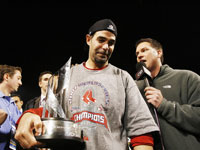 ey, he takes pride in his game and is naturally competitive. I'm just pointing out the facts. Two, I don't think the Sox will end up resigning him, but not because they don't want to. They will be hesitant to offer him any contract longer than 3 years (with a club option for the 4th), and someone out there will give him more years. More years means more guaranteed money. If the Sox offer him a 3 year deal at $12 million per, and someone else offers him a 5 year deal at the same money, he'll take the second deal. Can you blame him? I hope they resign him, he's a valuable part of the team and one I'd hate to see get away. I'm just not sure it's going to happen. Which leads us to the next question...
Go after A-Rod? We Sox fans shudder at the thought of A-Rod wearing a Red Sox uniform. After all, purple lipstick doesn't coordinate well with Fenway green. He is what ever fan loves to hate: he get's paid more than anyone ever should, he's a prima do nna, he plays in a way that is considered "bush league" (slapping the ball out of Arroyo's glove in 2004 [see picture], distracting an infielder on a popup this year), and worst of all, he doesn't perform well in the postseason. In the world of sports, those are good reasons not to like a player. No one can deny his statistics during the regular season, but when you pay someone that much money, you want postseason results. I hope the Sox take this into consideration.
 nna, he plays in a way that is considered "bush league" (slapping the ball out of Arroyo's glove in 2004 [see picture], distracting an infielder on a popup this year), and worst of all, he doesn't perform well in the postseason. In the world of sports, those are good reasons not to like a player. No one can deny his statistics during the regular season, but when you pay someone that much money, you want postseason results. I hope the Sox take this into consideration.
Here are a couple things to think about. One, A-Rod is looking for a deal of $30 million per year for at least 5 seasons, probably more. For that money, we can resign Lowell and go after another pitcher or two to help our rotation/bullpen. Two, he would probably bring too much baggage into the clubhouse, and the Boston team thrives on a laid back, "we are family" type atmosphere. Even though I'm sure A-Rod isn't the incarnation of evil as some seem to suppose, he has never been known to help team chemistry. Three, we have won 2 World Series with A-Rod playing for our biggest rival in our own division! How valuable can he be? Do we really need him? Would Theo really tie up that much money in a guy we have won 2 titles without?
I hope the answer is "no." We don't need him, in fact, he needs the Sox more than the Sox need him. Let him go to Chicago, or LA, or LA of Anaheim.
Free Agents? The Sox could use another pitcher if Schilling leaves. We'll be bringing back Beckett, Wakefield, Dice-K, Lester and Buckholz, who could join the rotation next year. Wakefield is becoming more injury prone in his old age, the Sox will need some insurance for him. They could also use some help in the bullpen, since Timlin is only getting older, Gagne will be (thankfully) gone and Okajima, while great, can get worn out. As for the offense, I'd guess that Coco Crisp will end up being traded to make room for Jacoby Ellsbury, the man who won all of America a free taco (see picture). Unfortunately, Drew will be back, since no one will take him. If Lowell walks and the Sox don't sign A-Rod, then they'll have to fill the 3rd base position and have no one in the minors to do so anytime soon. They do have the option of moving Youkilis to 3rd, his original position, and signing a 1st baseman (Carlos Pena from Tampa Bay?). Either way, they are in a good position: they don't have to make any major moves other than figuring out what to do with Lowell. That's a good place to be in coming off a championship.
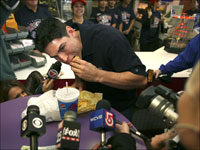 one will take him. If Lowell walks and the Sox don't sign A-Rod, then they'll have to fill the 3rd base position and have no one in the minors to do so anytime soon. They do have the option of moving Youkilis to 3rd, his original position, and signing a 1st baseman (Carlos Pena from Tampa Bay?). Either way, they are in a good position: they don't have to make any major moves other than figuring out what to do with Lowell. That's a good place to be in coming off a championship.
After 2004, the front office decided to shake things up. They let Orlando Cabrera go and signed Edgar Renteria, who they thought was an upgrade. They let Dave Roberts, one of their most important backups, walk and never found a way to replace him. They let two pitchers, Pedro Martinez and Derek Lowe, walk and never filled the whole. I hope they learned not to mess around this time. If you can win with this team as currently constituted, then there's no need to play around. Patch a few holes, let your young guys play and don't mess with success.
when "being myself" is a sin
Lisa and I just got our wedding video the other day and had a chance to sit down and watch it. It was great to look the ceremony again, relive some of our favorite parts (the hymns, of course, rank near the top of the list), and see our friends and family who attended. Most importantly, there is no video evidence of me making a fool of myself on the dance floor, therefore it may never have happened. Nice.
But there was something in the video that helped me see something I did not know about myself. During the ceremony, I looked completely unemotional. Honestly, my facial expressions barely changed throughout, it was eye-opening to me. What disturbs me is that I loved the ceremony and was genuinely moved throughout, there were a few times where I thought I would end up crying (and did, during How Great Thou Art). I can point those times out in the video, but if you didn't know me, you'd probably never think that was the case. After running this revelation across a few other people, I've been informed that this is often the case with me.
There's nothing wrong with looking unemotional, of course. I'm not a guy who wears his emotions on his sleeve, though I'd bet I'm more emotional than some might think. But this also brought to mind something I felt conviction over this past summer. You see, I was a part of a faithgroup (small group) in our church led by my good friends Matt & Pam. Every week Pam would prepare a time of worship through singing for us, but most of us rarely sang. It basically turned into the Matt and Pam Family Singalong, with a couple others singing in a barely audible voice.
I was convicted, however, in my failure to worship as a part of the community in these times. See, I often like to listen to the congregation worship on Sunday mornings. Hearing the voices of God's people singing can be a powerful experience. I also like to spend more time thinking about the words and what they teach us about God. These are both perfectly acceptable ways to worship.
However, in a smaller corporate worship setting, it may be inappropriate to do this all the time. Here's why: corporate worship, by definition, is a time for a group of people to worship the Lord in unity. While we may "connect with God" personally, that is not the primary goal of corporate worship (see some thoughts on corporate worship here and note in particular Jeremy's comment). In a smaller group, it can actually be selfish, and it certainly was for me. Sure, I can trot out the "I have a horrible voice, I'm saving you from the pain" argument (which is true, to be sure), but that again is selfish. If my silence causes discouragement for someone else, in particular the leaders, then my worship is self-focused, not blessing God or my brothers and sisters.
I can't turn myself into someone who suddenly shows every emotion on his face: I wouldn't even know how, and it would probably be dishonest to do so. However, I can, especially in corporate worship times, do a better job of promoting unity in the Spirit by participating more. A lack of participation is not "being myself", it is being selfish. And that is a sin.
But there was something in the video that helped me see something I did not know about myself. During the ceremony, I looked completely unemotional. Honestly, my facial expressions barely changed throughout, it was eye-opening to me. What disturbs me is that I loved the ceremony and was genuinely moved throughout, there were a few times where I thought I would end up crying (and did, during How Great Thou Art). I can point those times out in the video, but if you didn't know me, you'd probably never think that was the case. After running this revelation across a few other people, I've been informed that this is often the case with me.
There's nothing wrong with looking unemotional, of course. I'm not a guy who wears his emotions on his sleeve, though I'd bet I'm more emotional than some might think. But this also brought to mind something I felt conviction over this past summer. You see, I was a part of a faithgroup (small group) in our church led by my good friends Matt & Pam. Every week Pam would prepare a time of worship through singing for us, but most of us rarely sang. It basically turned into the Matt and Pam Family Singalong, with a couple others singing in a barely audible voice.
I was convicted, however, in my failure to worship as a part of the community in these times. See, I often like to listen to the congregation worship on Sunday mornings. Hearing the voices of God's people singing can be a powerful experience. I also like to spend more time thinking about the words and what they teach us about God. These are both perfectly acceptable ways to worship.
However, in a smaller corporate worship setting, it may be inappropriate to do this all the time. Here's why: corporate worship, by definition, is a time for a group of people to worship the Lord in unity. While we may "connect with God" personally, that is not the primary goal of corporate worship (see some thoughts on corporate worship here and note in particular Jeremy's comment). In a smaller group, it can actually be selfish, and it certainly was for me. Sure, I can trot out the "I have a horrible voice, I'm saving you from the pain" argument (which is true, to be sure), but that again is selfish. If my silence causes discouragement for someone else, in particular the leaders, then my worship is self-focused, not blessing God or my brothers and sisters.
I can't turn myself into someone who suddenly shows every emotion on his face: I wouldn't even know how, and it would probably be dishonest to do so. However, I can, especially in corporate worship times, do a better job of promoting unity in the Spirit by participating more. A lack of participation is not "being myself", it is being selfish. And that is a sin.
Saturday, October 27, 2007
5.5 random things: world series edition
5.5: This post is dedicated to the handful of folks who still read this blog. It's funny, I think the least favorite posts on this blog are ones about sports, yet I managed to churn them out far more regularly than any other subject. Why is this? I'll give you the primary reason- they take little thought. I can pump out a Red Sox post in 20 minutes (most of which is spent checking my facts anyway), whereas a post on a biblical passage or theological issue requires much more thought and precision. So, I can assure you the quantity of posts on a given subject is not proportional to the importance I place on that subject, in fact, the inverse may be true.
5: Winning the first two games of the World Series was obviously important, but one reason I haven't heard anyone mention yet is this: we don't have to pitch Josh Beckett on 3 days rest in Game 4. Even if the Sox lose tonight, they still have a 2-1 lead going into Game 4, and you would only pitch Beckett if it were a must win game.
4: It was weird seeing Schilling walking off the mound on Thursday night and think that it may have been the last time he does that in a Red Sox uniform. Yes, he has fallen quite a bit over the last couple years as a pitcher, but that is largely due to him pitching with his ankle all sown up in 2004. The question some are asking now: is Schilling a Hall of Fame pitcher? Here are my thoughts, in a nutshell. If you are looking purely at stats and comparing them to Hall of Famers, then no, he shouldn't be elected. But when you consider that pitching statistics have changed so much over the years, I'm not sure that should be the deciding factor (just at hitters with impressive stats today should automatically be elected). His postseason exploits are legendary, and that has to count for something. And think about this: Jim Bunning, Don Drysdale, Bob Lemon, Hal Newhouser, Gaylord Perry, and Don Sutton are all in the Hall of Fame. Are any of those guys really better than Curt Schilling?
3: Some of Francona's decisions made throughout the year have been proven to be genius. Two that stand out as particularly sucessful: giving Papelbon frequent rest throughout the season, and shutting down Okajima for a month near the end of the season. Both look extrememly healthy and sharp right now, and the numbers bear it out. They have been practically unhittable, and I'm beginning to wonder if Okajima could win Series MVP (even without a win or a save) if he has another game like Game 2 (7 batters, 7 outs, including getting out of a Schilling jam).
2: Francona has been put in a difficult position of choosing between Mike Lowell, Kevin Youkilis and David Ortiz to play in Colorado (where there is no DH). He has opted to sit Youkilis, at least for part of their time there. That's a tough decision, and even though Youkilis is their hottest hitter, I think it may be the correct one. Sitting Lowell is difficult, his defense is outstanding and he's been swinging a great bat. I'm not sure how you can sit Ortiz, he's the best clutch hitter of his generation and hitting just fine. Youkilis is obviously a better defensive first baseman, but that rarely comes into play (and he'll get in late in the games when defense becomes especially important). And while Youkilis is hitting the cover off the ball, let's not forget he's doing so in large part due to Ortiz and Manny hitting behind him. Take Ortiz out of the equation, and I'm not sure Youkilis is batting over .500. Anyway, Francona may consider sitting Ortiz in game 5 with the left handed pitcher.
1: A few things that have stuck out to me:
I can't believe Matt Holliday got picked off first in the 9th the other night. That has to be the biggest baserunning blunder in the World Series since Jeff Suppan's brain lapse in Game 3 of 2004.
Coco Crisp has fallen so far that the Sox will barely be able to get anything for him in a trade this offseason. Can you say "package deal?"
Dice-K has recently been described as a "power nibbler", which I think is pretty accurate. He's hoping he stops nibbling and starts pitching tonight.
Can you believe JD Drew is the team leader in hitting and slugging in the World Series?
The Sox scored 15 runs in 2 games, and the only homerun was from Dustin Pedroia.
Comparing the pitching staffs: Sox pitchers have given up 3 walks and 11 hits in Games 1&2, Rockies pitchers have given up 15 walks and 23 hits.
There's an old saying in baseball: momentum is only as strong as the next day's starting pitcher. The Rockies can turn this around quickly if they get a strong performance from Josh Fogg tonight.
5: Winning the first two games of the World Series was obviously important, but one reason I haven't heard anyone mention yet is this: we don't have to pitch Josh Beckett on 3 days rest in Game 4. Even if the Sox lose tonight, they still have a 2-1 lead going into Game 4, and you would only pitch Beckett if it were a must win game.
4: It was weird seeing Schilling walking off the mound on Thursday night and think that it may have been the last time he does that in a Red Sox uniform. Yes, he has fallen quite a bit over the last couple years as a pitcher, but that is largely due to him pitching with his ankle all sown up in 2004. The question some are asking now: is Schilling a Hall of Fame pitcher? Here are my thoughts, in a nutshell. If you are looking purely at stats and comparing them to Hall of Famers, then no, he shouldn't be elected. But when you consider that pitching statistics have changed so much over the years, I'm not sure that should be the deciding factor (just at hitters with impressive stats today should automatically be elected). His postseason exploits are legendary, and that has to count for something. And think about this: Jim Bunning, Don Drysdale, Bob Lemon, Hal Newhouser, Gaylord Perry, and Don Sutton are all in the Hall of Fame. Are any of those guys really better than Curt Schilling?
3: Some of Francona's decisions made throughout the year have been proven to be genius. Two that stand out as particularly sucessful: giving Papelbon frequent rest throughout the season, and shutting down Okajima for a month near the end of the season. Both look extrememly healthy and sharp right now, and the numbers bear it out. They have been practically unhittable, and I'm beginning to wonder if Okajima could win Series MVP (even without a win or a save) if he has another game like Game 2 (7 batters, 7 outs, including getting out of a Schilling jam).
2: Francona has been put in a difficult position of choosing between Mike Lowell, Kevin Youkilis and David Ortiz to play in Colorado (where there is no DH). He has opted to sit Youkilis, at least for part of their time there. That's a tough decision, and even though Youkilis is their hottest hitter, I think it may be the correct one. Sitting Lowell is difficult, his defense is outstanding and he's been swinging a great bat. I'm not sure how you can sit Ortiz, he's the best clutch hitter of his generation and hitting just fine. Youkilis is obviously a better defensive first baseman, but that rarely comes into play (and he'll get in late in the games when defense becomes especially important). And while Youkilis is hitting the cover off the ball, let's not forget he's doing so in large part due to Ortiz and Manny hitting behind him. Take Ortiz out of the equation, and I'm not sure Youkilis is batting over .500. Anyway, Francona may consider sitting Ortiz in game 5 with the left handed pitcher.
1: A few things that have stuck out to me:
I can't believe Matt Holliday got picked off first in the 9th the other night. That has to be the biggest baserunning blunder in the World Series since Jeff Suppan's brain lapse in Game 3 of 2004.
Coco Crisp has fallen so far that the Sox will barely be able to get anything for him in a trade this offseason. Can you say "package deal?"
Dice-K has recently been described as a "power nibbler", which I think is pretty accurate. He's hoping he stops nibbling and starts pitching tonight.
Can you believe JD Drew is the team leader in hitting and slugging in the World Series?
The Sox scored 15 runs in 2 games, and the only homerun was from Dustin Pedroia.
Comparing the pitching staffs: Sox pitchers have given up 3 walks and 11 hits in Games 1&2, Rockies pitchers have given up 15 walks and 23 hits.
There's an old saying in baseball: momentum is only as strong as the next day's starting pitcher. The Rockies can turn this around quickly if they get a strong performance from Josh Fogg tonight.
Wednesday, October 24, 2007
more from the wedding
Some of you may have heard that I got married to a wonderful young lady named Lisa on October 6 (see my post a few days ago). The wedding was perfect and the reception was tons of fun. I'll throw a few pictures up with some comments.
 Here we are during one of the hymns, you can see our pastor, Sean, in the background. You've heard mention the Charles Wesley Corollary before (my old roommate, and fellow newlywed, Jonathan calls it the Hymns-Spirit Theorem). The thought is that "the power of the Spirit evident in any given meeting is proportional to the quality and quantity of hymns that are sung." Lisa and I aimed high for our wedding, singing 3 of my favorites: Be Thou My Vision (click the Corollary link for some thoughts on that hymn), Come Thou Fount and How Great Thou Art, my favorite hymn of all. Well, the Corollary held true in our wedding, it was a powerful time of worship for everyone. Part of our goal for the wedding was to honor God by celebrating His goodness and grace, and I felt like we were able to do that during this time.
 Here we are during one of the hymns, you can see our pastor, Sean, in the background. You've heard mention the Charles Wesley Corollary before (my old roommate, and fellow newlywed, Jonathan calls it the Hymns-Spirit Theorem). The thought is that "the power of the Spirit evident in any given meeting is proportional to the quality and quantity of hymns that are sung." Lisa and I aimed high for our wedding, singing 3 of my favorites: Be Thou My Vision (click the Corollary link for some thoughts on that hymn), Come Thou Fount and How Great Thou Art, my favorite hymn of all. Well, the Corollary held true in our wedding, it was a powerful time of worship for everyone. Part of our goal for the wedding was to honor God by celebrating His goodness and grace, and I felt like we were able to do that during this time.
Sorry to post a picture of us smo oching, but it was part of the ceremony, so what do you want from me? You'll see my best man, Ryan, giving his approving smile in this picture. You may remember Ryan from a post from a little over a year ago entitled I went to a worship service and a wedding broke out, which was my running diary of his wedding weekend. I had the pleasure of being his best man, so I was happy to return the honor. He was a great best man; I was psyched we were able to continue our tradition of going to Dunkin' Donuts on Saturday morning (as we did in seminary, and on his wedding day).
 oching, but it was part of the ceremony, so what do you want from me? You'll see my best man, Ryan, giving his approving smile in this picture. You may remember Ryan from a post from a little over a year ago entitled I went to a worship service and a wedding broke out, which was my running diary of his wedding weekend. I had the pleasure of being his best man, so I was happy to return the honor. He was a great best man; I was psyched we were able to continue our tradition of going to Dunkin' Donuts on Saturday morning (as we did in seminary, and on his wedding day).
 So here we are for our first dance, wit h Direct Effect playing Ray LaMontagne's song Hold You in My Arms. I don't mind slow dancing, but I hate any other form of dancing. But, as a good husband ought to do, I made a fool of myself on the dance floor for the sake of my wife, who happens to love dancing. Don't worry, I was repaid by being able to watch the Red Sox and Patriots on our honeymoon. See, we're learning how to compromise already!
 h Direct Effect playing Ray LaMontagne's song Hold You in My Arms. I don't mind slow dancing, but I hate any other form of dancing. But, as a good husband ought to do, I made a fool of myself on the dance floor for the sake of my wife, who happens to love dancing. Don't worry, I was repaid by being able to watch the Red Sox and Patriots on our honeymoon. See, we're learning how to compromise already!
In all seriousness, the wedding turned out to be exactly what we wanted it to be: a celebration of the goodness of our God. We gave Sean one simple instruction: preach the gospel. At the very least, we wanted folks to come away with an understanding that there is a God in heaven who is gracious and compassionate, slow to anger and abounding in love. We chose our Scripture reading accordingly: Ephesians 2:1-10 and Psalm 103. We had so many folks come up to us and tell us how blessed they were by the service, and many mentioned how moved they were during How Great Thou Art. Lisa and I were so honored to know that the character of God was proclaimed clearly in both the preaching and the hymns, and we're thankful for the opportunity to worship the Lord in this setting.
Tuesday, October 23, 2007
Red Sox vs Rockies: 2007 World Series thoughts
For the 2nd time in 4 years the Red Sox have made the World Series. For the 1st time in their relatively short existence, the Rockies are making an appearance. I realize the oddsmakers are practically handing the Sox the title, but I'm not sure how anyone can dismiss a team that has won 21 of their last 22, including sweeping the first 2 rounds of the playoffs. Maybe it's the pre-2004 Sox fan still grumbling within me, but I'm not that confident. Here are some thoughts about what I think is not going for them, followed by a list of things working in their favor.
What is working against the Sox:
Colorado's hot streak.
Inconsistent offense
4 inches of snow in Denver
Inconsistency from any starter not named Beckett
Gagne-Lopez-Delcarmen (8 2/3 innings, 10 runs in the postseason)
Setting a record for hitting into double plays
Manny's grasp of the English language
Papelbon dancing in spandex
What is working for the Sox:
Josh Beckett
An offense that finally came alive (example: Youkilis batting .500 in the ALCS)
Putting Jacoby Ellsbury in for Coco Crisp
Homefield advantage (a big deal for this Sox team)
Timlin-Okajima-Papelbon (17 innings, 0 runs in the postseason)
Schilling remembering he's a clutch pitcher (may forget by his next start, though)
We have the advantage of pitching Josh Beckett in game 1, which gives Francona 2 options: pitch him on 3 days rest for games 4 and, if necessary, 7 or more likely pitch him on regular rest for game 5 and in relief after that (if necessary, of course). There is no doubt that Beckett is the most valuable player on this team for the postseason. He is the only starter with any sort of consistency, someone who is quickly turning his postseason exploits into legendary status. In 8 career postseason starts he has thrown 3 shutouts. This year he has walked only 1 batter in 23 innings allowing only 15 baserunners in those 23 innings. If I'm Colorado, I'm a little worried about facing him to start the series. You can't plan on scoring a lot of runs on him, so you have to make him throw a lot of pitches early and get to the bullpen (note the Gagne, Lopez, Delcarmen trifecta of crappiness).
If I'm Francona, I'd drop Gagne from the roster for the World Series and put Tavarez back on. Hopefully you won't need him, but he certainly can do better than Gagne, especially if you need a pitcher to go a few innings in an extra-inning game. I'd also leave Ellsbury in for Crisp (that's a no brainer) but not fall to the tempation of benching Lugo for Cora (who, contrary to the belief of some, would not be any better).
To be honest, I'm not sure what all there is to say about this series. I feel like at this point in the season we know what we are getting from everyone involved. The question is this: will the proven clutch players on the Sox (Beckett, Schilling, Ortiz, Manny, etc) keep it up or will this be the year that the younger, unknown players from the Rockies begin to make a name for themselves. The Sox just faced a similar team in a similar situation in Cleveland (who could be great for years to come), and proved that their experience was able to overcome. Here's hoping the same happens in this series.
Prediction: Red Sox in 6, Manny Ramirez World Series MVP #2, repeating his famous line after the 2004 World Series victory "I don't believe in curses, I believe you make your own destination." (Note, I actually think Beckett will win MVP, but I wanted to fit the Manny line in here somewhere.)
What is working against the Sox:
Colorado's hot streak.
Inconsistent offense
4 inches of snow in Denver
Inconsistency from any starter not named Beckett
Gagne-Lopez-Delcarmen (8 2/3 innings, 10 runs in the postseason)
Setting a record for hitting into double plays
Manny's grasp of the English language
Papelbon dancing in spandex
What is working for the Sox:
Josh Beckett
An offense that finally came alive (example: Youkilis batting .500 in the ALCS)
Putting Jacoby Ellsbury in for Coco Crisp
Homefield advantage (a big deal for this Sox team)
Timlin-Okajima-Papelbon (17 innings, 0 runs in the postseason)
Schilling remembering he's a clutch pitcher (may forget by his next start, though)
We have the advantage of pitching Josh Beckett in game 1, which gives Francona 2 options: pitch him on 3 days rest for games 4 and, if necessary, 7 or more likely pitch him on regular rest for game 5 and in relief after that (if necessary, of course). There is no doubt that Beckett is the most valuable player on this team for the postseason. He is the only starter with any sort of consistency, someone who is quickly turning his postseason exploits into legendary status. In 8 career postseason starts he has thrown 3 shutouts. This year he has walked only 1 batter in 23 innings allowing only 15 baserunners in those 23 innings. If I'm Colorado, I'm a little worried about facing him to start the series. You can't plan on scoring a lot of runs on him, so you have to make him throw a lot of pitches early and get to the bullpen (note the Gagne, Lopez, Delcarmen trifecta of crappiness).
If I'm Francona, I'd drop Gagne from the roster for the World Series and put Tavarez back on. Hopefully you won't need him, but he certainly can do better than Gagne, especially if you need a pitcher to go a few innings in an extra-inning game. I'd also leave Ellsbury in for Crisp (that's a no brainer) but not fall to the tempation of benching Lugo for Cora (who, contrary to the belief of some, would not be any better).
To be honest, I'm not sure what all there is to say about this series. I feel like at this point in the season we know what we are getting from everyone involved. The question is this: will the proven clutch players on the Sox (Beckett, Schilling, Ortiz, Manny, etc) keep it up or will this be the year that the younger, unknown players from the Rockies begin to make a name for themselves. The Sox just faced a similar team in a similar situation in Cleveland (who could be great for years to come), and proved that their experience was able to overcome. Here's hoping the same happens in this series.
Prediction: Red Sox in 6, Manny Ramirez World Series MVP #2, repeating his famous line after the 2004 World Series victory "I don't believe in curses, I believe you make your own destination." (Note, I actually think Beckett will win MVP, but I wanted to fit the Manny line in here somewhere.)
Subscribe to:
Posts (Atom)


